
Guide
Decorative timber trusses
A decorative timber truss is an exposed truss built to be seen: over a porch or an entry, under a vaulted ceiling, or across a pavilion, its timbers joined by steel plates bolted on both faces. This guide shows the truss types and the plates each one takes, how to fit them to your timbers and your roof's pitch, and where a steel tie rod can take the place of a timber.

01 Uses
Where decorative trusses go
Most of the trusses our plates join go up in three places: a porch, entry, or carport gable, where the truss fills the gable's end; a great room or vaulted ceiling, where trusses cross the room under the roof; and pavilions and pergolas, where the whole frame is open to view. Some are purely decorative, hung under a roof that is framed and carried on its own. Others are part of the frame: see decorative or carrying a load.
-
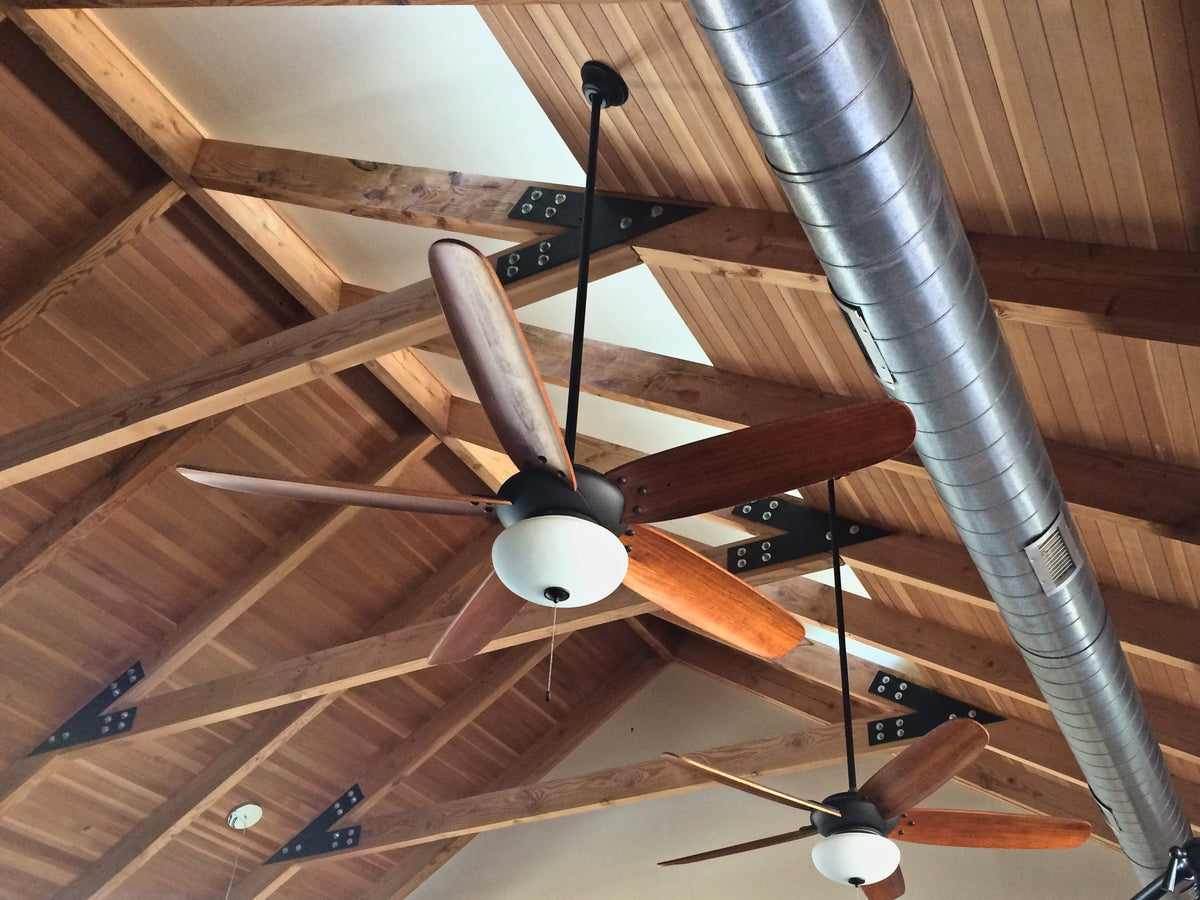
Great room -

Pool pavilion -
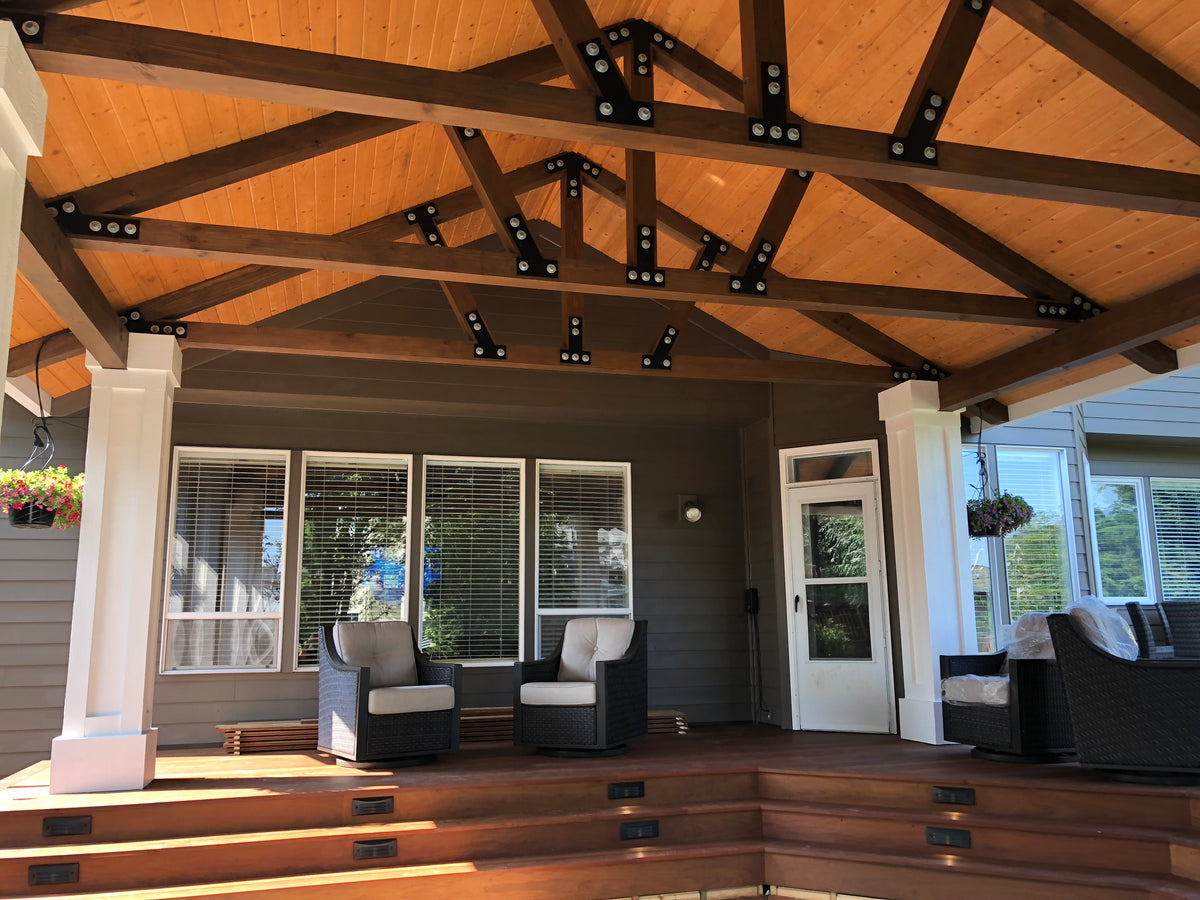
Porch in California -
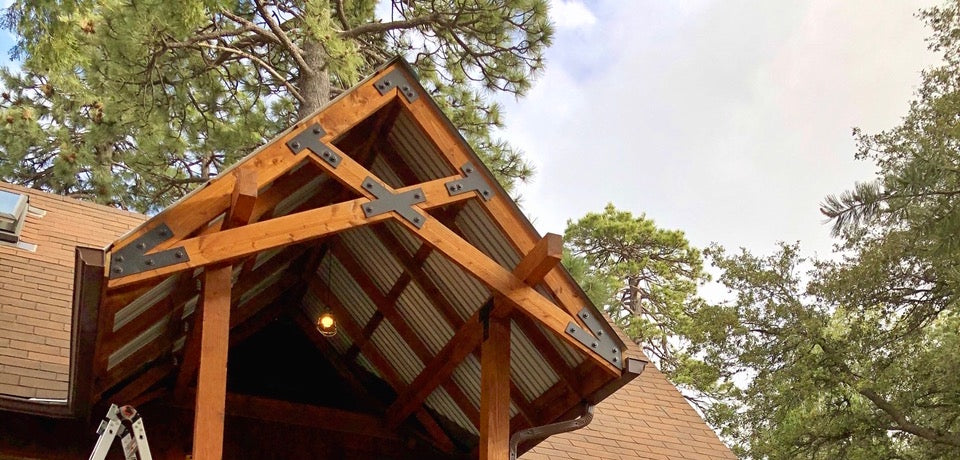
Porch in Washington

02 Trusses
Plan your truss
Planning a truss takes three choices: the style of truss, the collection that fits your timbers, and your roof's pitch.
Step 1: Choose your truss
Each plate is named for what it does; its letters are its part number. Plates are sold singly and used in pairs, one on each face of the timber, so the counts below are for one truss, both faces. The drawings show each truss with the plates our designers make, 4" wide on every leg. Scissor trusses, whose bottom chords slope up toward the middle, take fan and heel plates made for that slope: we make them by quote, through the quote form.

King post truss with struts
The traditional complete truss. 2 king post, 2 fan, 4 strut, and 4 heel plates.

King post truss
A king post without struts. 2 king post, 2 T, and 4 heel plates.

Queen post truss
The king post truss with struts, with a queen post under each rafter where its strut meets it, for a fuller frame across a wide room. 2 king post, 2 fan, 4 queen post, 4 T, and 4 heel plates. The queen post plates are made to your timbers in the queen post plate designer.

Truss with struts, no king post
A more modern shape, open in the middle. 2 peak, 2 strut fan, 4 strut, and 4 heel plates.

Open truss
Rafters and a bottom beam only, for an open, airy look. 2 peak and 4 heel plates.

Raised tie beam
No truss at all: frame the roof first, then raise a beam that hangs between the rafters, like a collar tie. 2 peak and 4 collar tie plates.
Prefer slim steel to a timber beam? See tie rod trusses below.


Step 2: Design your plates, or choose a collection
Design your own (recommended). Our custom plate designers make every plate a truss needs to your timbers' actual sizes: centered on them, with the reveal you want, and with holes for your fastener. You see each plate drawn on your timbers, and its price, before you order, and the design costs nothing extra: you pay for the steel. A timber truss can outlast all of us, so it's worth knowing every plate fits and looks exactly the way you want. Start with the king post, heel, strut, or queen post plate. A truss that sits on columns rather than a wall takes the heel post plate, a heel plate with a leg down the column.
Or choose a collection. Builders who know their joints often order our stock plates as they are. Each collection is drawn for a range of timbers in actual widths, and the range is a general guide: a plate fits timbers across it, but not centered on every combination of sizes in it. A plate's part number is its letters plus the collection's code: the king post truss plate is W3 in Cornice and W6 in Massif.
- Cornice, for 3" to 6" timbers: parts W3, F3, Y3, VB3…
- Taiga, for 4" to 8" timbers: parts W4, F4, Y4, VB4…
- Cuesta, for 4" to 8" timbers: parts WC4, FC4, YC4, VBC4…
- Massif, for 6" to 10" timbers: parts W6, F6, Y6, VB6…
- Esker, for 6" to 10" timbers: parts WE6, FE6, YE6, VBE6…
- Sierra, for 8" to 12" timbers: parts W8, F8, Y8, VB8…
Measure your timbers: a surfaced timber is 1/2" under its name, so a store-bought 4x4 is 3 1/2" square, while rough-sawn timber is usually full size. The size to watch is a range's smallest: a Taiga plate won't fit a surfaced 4x4, and a Sierra plate won't fit a surfaced 8x8.
-
 Cornice W3-1212
17-5/8" x 14-3/4", 8 holesfor 3" to 6" timbers
-
 Taiga W4-1212
17-15/16" x 18", 9 holesfor 4" to 8" timbers
-
 Cuesta WC4-1212
17-7/16" x 17-1/8", 9 holesfor 4" to 8" timbers
-
 Massif W6-1212
19-13/16" x 17-9/16", 8 holesfor 6" to 10" timbers
-
 Esker WE6-1212
19-13/16" x 19-9/16", 12 holesfor 6" to 10" timbers
-
 Sierra W8-1212
37-11/16" x 26-1/2", 16 holesfor 8" to 12" timbers


12" at this scale. Each collection’s king post truss plate at 12/12, from its cutting file.
Step 3: Choose your pitch and thickness
- Pitch: plates that meet the rafters (king post, peak, strut, queen post, heel, and collar tie) are cut for your roof's pitch. Every plate is cut to order: the stock plates come in pitches from 3/12 to 12/12, and the designers draw each plate at yours.
- Finding your pitch: take it from your plans whenever you have them. Measuring an existing roof is less exact, so measure over a long run. From a point on the underside of a rafter, measure 4, 5, or 6 feet out level, drop a plumb line there to the rafter, and measure the drop. Divide it by the feet you went out: a 30" drop over 5 feet is 6" per foot, a 6/12 pitch. A measurement is off by about the same amount however far you go, so the longer the run, the closer the answer.
- Thickness: both of our thicknesses, 3/16" and 1/4", have the heft that heavy timber calls for. The thin steel hardware sold online and at big-box stores looks fake next to a real timber. Only an engineer can say which thickness a structure needs; we have seen engineered plans call for both, and most call for 1/4".
- Hardware: stock plates have 11/16" holes for 5/8" bolts, and you can choose another size on any plate's page; the designers make the holes for your fastener. Threaded rod with washers and nuts looks the same on both faces; bolts leave a head on one side. On purely decorative work, you can lag-screw single plates instead of bolting pairs through.

03 Tie rods
Timber or steel: tie rod trusses
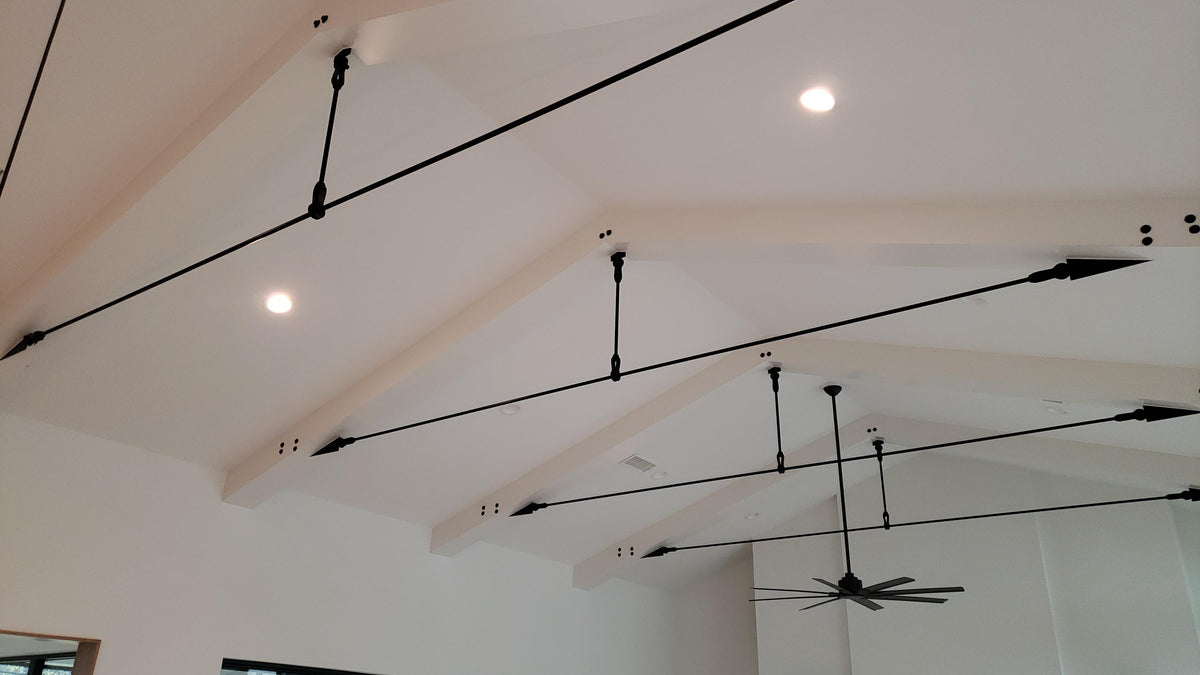
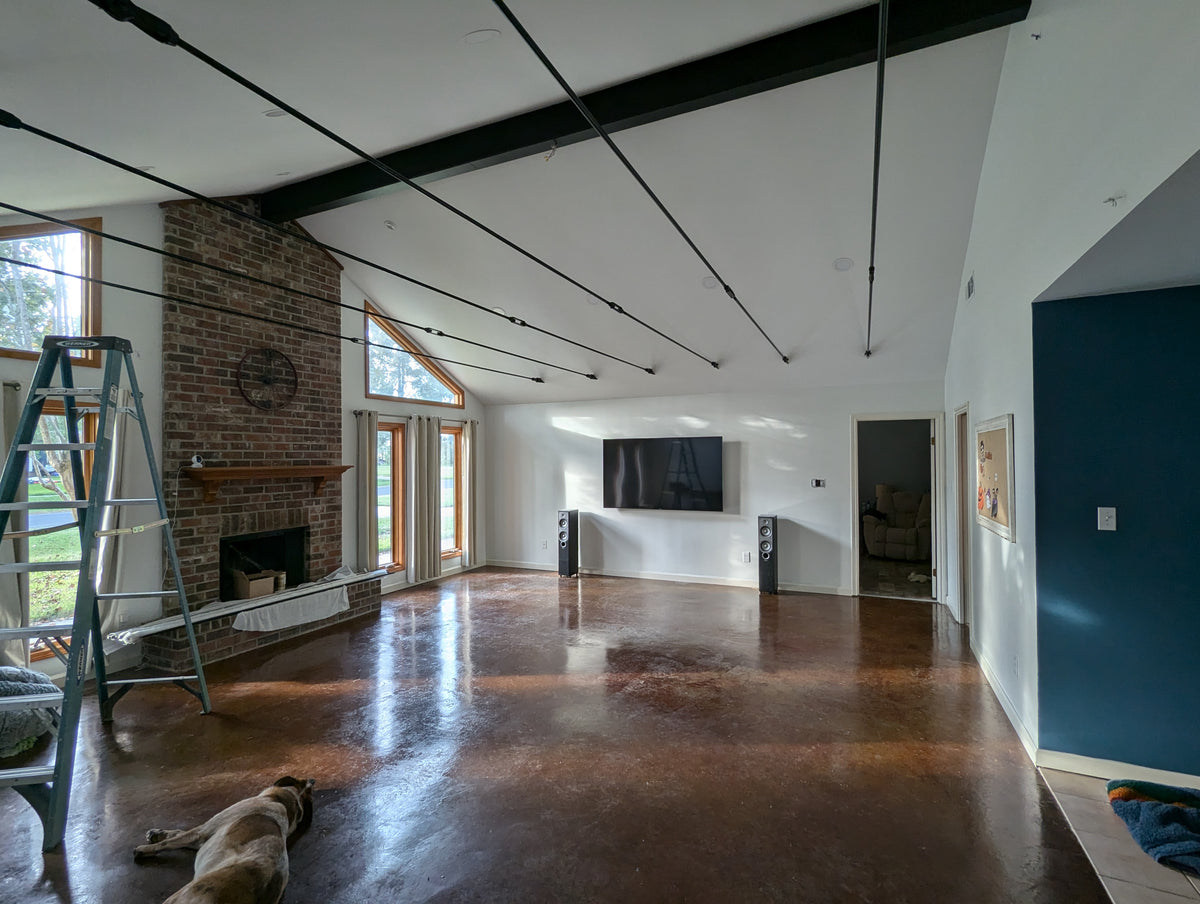
The trusses above have steel twins. Our steel collar ties run the same lines in black steel rod: a level rod where a timber tie beam would cross the room, and rods rising where a king post or struts would, all meeting at a steel center plate. A timber truss makes a heavy, traditional frame; a tie rod truss keeps the room open, a slim line under the ceiling. We make both: the plates for timber, and the rods, brackets, center plates, and turnbuckles for steel, priced online as you design. Past a span of about 18 to 20 feet, the level rods need support at the center from above: choose a 3-, 4-, or 5-point system.

2-point: the open truss in steel
One level rod from rafter to rafter, with an optional turnbuckle to tighten it. Where a raised tie beam or an open truss's bottom beam would be. Design a 2-point system

3-point: the king post truss in steel
Level rods meet at a center plate, with a vertical rod up to the ridge where the king post would be. Design a 3-point system

4-point: the struts, no king post, in steel
Level rods with two diagonal rods up to the rafters, where the struts would be, all meeting at a center plate. Design a 4-point system

5-point: the king post truss with struts in steel
Level rods with a vertical rod to the ridge and two diagonal rods to the rafters, all meeting at a center plate. Design a 5-point system


04 Engineering
Decorative or carrying a load
A truss hung under a roof that is framed and carried on its own is decoration. A truss that holds up a roof or a ceiling is structure, and its timbers, plates, and bolts are for your plans or your engineer to size. Our plates and tie rods are architectural hardware, not engineered or load-rated. Give your engineer the dimensioned drawing on each plate's page.
05 Ordering
Ordering your plates
Everything we make is priced the same way: by the pounds of steel and the inches of weld it takes. Whether you pick a stock design, build your own in one of our online configurators, or send us a drawing, you pay for steel and welding, never for the design. Customization is free.

1. Choose a stock design
Our plate collections and standard brackets are ready to order at listed prices. Pick a truss style and a collection, and add the plates to your cart. The truss steps above show exactly which plates each truss needs.
- Truss plate collections: six styles, for timbers from 3" to 12"
- Heavy-duty angle brackets: stock sizes in 1/4" steel

2. Design it online
Where your project needs something made to measure, our configurators let you enter your dimensions, see the part in 3D, get the price instantly and order, with no waiting for a quote.
- Tie rod systems: awnings and canopies, walls and columns, and vaulted ceilings from 2 to 5 points
- Column caps and bases: caps, corner caps, cross caps and bases sized to your posts
- Joist hangers: internal and external flange hangers for heavy timber
- Custom angle brackets: set the height, length, width, fastener size and corner style, in 1/4" A36 steel
- 17-15/16"18"w4-1212.dxf
9 holes 11/16" DIA3. Ask us for a custom design
If a stock design or configurator doesn't give you what you need, call us or send a sketch. We'll design the part with you, at no charge for the design. You pay for the steel and welding, on the same basis as everything on the site. Changing a hole pattern, a width or a spoke is often a quick answer on the phone.


06 Trade
For builders, architects and designers
We fabricate from plans. Send us your drawings, details or a cut list, and we'll price them the way we price everything else: pounds of steel and inches of weld. That leaves you free to design whatever the project calls for, without worrying that a custom connector will cost more than a catalog one.
- Plans and drawings: send them through our quote form.
- Large orders: we regularly supply whole projects; see how we delivered 14,000 lbs of connectors for one amenity center.
- Engineering: we build to your specifications; structural design and approval stay with the project's engineer.
07 FAQ
Common questions
More answers are in our FAQs.
What is a decorative truss?
An exposed timber truss built to be seen: over a porch or an entry, under a vaulted ceiling, or across a pavilion, with steel plates at its joints. Some are purely decorative; others carry the roof and are sized by an engineer.
What is the difference between a king post and a queen post truss?
A king post truss has one post at the center, from the peak down to the tie beam. A queen post truss adds a post under each rafter where its strut meets it, for a fuller frame across a wide room. Both are drawn above with the plates each takes.
Do you sell finished trusses?
No: we make the steel plates, and your framer or builder makes the truss. Send us the drawings and we will price every plate.
Can you make plates for a scissor truss?
Yes, by quote. Our king post and strut plates fit as they are; the fan and heel plates are made for the slope of the bottom chords. Send your drawings through the quote form.
Timber tie beam or steel tie rod?
It comes down to the look: a timber beam makes a heavy, traditional frame, and a steel rod a slim line that keeps the room open. Whether a roof needs a tie at all is for your plans or your engineer. See tie rod trusses above.
Do you do custom orders?
Yes! We love designing the perfect item for our customers' unique needs. We don't charge for design; you pay only for the steel and welding. Use our quote form for a customized quote. Please be sure to include:
- Your name
- Phone number
- Any designs or drawings you have
- Steel thickness
- Whether you would like powder coating
- The shipping address
We can take it from there.
Which collection should I use?
In general, the timber width determines the collection you choose. We usually recommend leaving a wood "reveal" around the plates rather than having the plates go right to the edge of the wood. Also, please be aware that “dimensional lumber” is specified in nominal dimensions. For example, a 4 x 4 dimensional lumber post like you would buy at a big box store is actually 3 ½” x 3 ½”, so our 4” wide Taiga plates would actually extend past the edge of the lumber. Rough-sawn lumber is typically specified in actual dimensions, so a rough-sawn 8x8 will be roughly 8" by 8".
If in doubt, call us, and we will work with you to select the best choice for your application.
What steel thickness should I choose?
3/16" is our standard thickness and suits most decorative work. 1/4" is heavier and stiffer. Our plates are architectural hardware, not engineered or load-rated: if a plate is part of how your structure carries load, have your engineer confirm the plate, its thickness, and its bolts. You and your engineer are responsible for its suitability.
Need another thickness? Please contact us for additional options.
What size are the bolt holes?
The standard hole size of our plates is 11/16” unless otherwise noted. These holes are designed for 5/8" bolts. Our awning and face-mounted brackets default to 1/4" fasteners. If you would like to use a fastener of a different diameter, please contact us. We can usually make that change for free, and our online configurators let you choose the hole size for your fastener.
What grade of steel do you use?
We use industry-standard A36 plate and 1018 cold-rolled rod. Tie rod assemblies, brackets included, are also available in 316 stainless steel by quote. If you need a custom grade of steel, please call for a quote.
What finishing options are available?
- Unfinished (included) - Mild steel rusts, so expect some superficial rust on your plates. In most cases, you can ignore it and apply your finish right over it, but if you really want, take some steel wool or sandpaper to it and wipe it off.
- Powder coat (additional cost) - Our matte black powder coat is gorgeous and one of the most durable finishes on the market. This is the preferred option for outdoor applications because of its UV stability. Matte black powder coating can be selected at checkout. Contact us if you need a different color.
- Galvanized - For outdoor installations in very wet environments or in environments close to the ocean, galvanizing is the best choice for rust resistance. Please contact us for a quote if you need your parts galvanized.
Do you offer galvanizing?
Yes! We do offer galvanizing. Please give us a call, and we can give you a quote. Please note that galvanizing adds substantially to lead times. Please plan accordingly.
How do I add powder coating to an order?
The powder coating option will appear above your cart during the checkout process.
Click the checkbox, and the cost will be added to your cart. It might take a second or two to refresh the screen. To remove powder coating, uncheck the box.
08 Questions
Questions?
Call us, request a quote, or see the FAQs for finishes, shipping and lead times. We like helping people get their projects right.